Why levels at all
When someone says "I use AI", most often it means one thing: I open ChatGPT, ask a question and copy the answer into my document. That is a normal start. But there is a big gap between this and how people work when AI really saves them days. The gap is not in knowing prompts, it is in the way of working.
Levels help name that way of working and see the next step. A level describes how you work now, not your profession, job title or talent. You can change it in a few weeks.
The four levels in brief
- 01AI in chatAI consumer
You ask, AI answers, you copy the answer. Like ordering food: it arrives ready, but the kitchen is not yours.
Result: an answer in a chat window - 02Vibe coderbuilds with words
You describe in words what you need, and AI builds a working thing: a page, a spreadsheet, a prototype. Like cooking from a recipe found online: tasty, but no guarantee you can repeat it.
Result: a prototype that works for you - 03Agentic engineerworks by a system
The agent has a project folder, rules, skills and checks. Your own cookbook: ingredients, a recipe, a taste test. The dish comes out the same every time.
Result: a skill or process for a recurring task - 04AI architectbuilds for the team
Builds a system of several agents and connections that the team uses. A restaurant kitchen: cooks, roles, rules. It works without you too.
Result: a system for the team
A level describes a way of working, not a profession or a talent.
A few words you will see here:
- Vibe coding - you describe the result in plain words, and AI writes the code. You do not write it or read it.
- Agent - an AI that does not just answer but acts on its own: opens files on your computer, creates new ones, runs checks. For example, Claude Code, Codex or Cursor.
- Skill - a saved instruction for an agent. You describe once how to do a task, and from then on the agent does it by that instruction.
- CLAUDE.md - a file with the project rules that the agent reads at the start of every task. In Codex this file is called AGENTS.md.
We did not invent the names of levels 2 and 3. The term "vibe coding" was coined in February 2025 by Andrej Karpathy, one of the founders of OpenAI and former director of AI at Tesla. Exactly a year later he himself called it yesterday's news and proposed a different name for professional work with agents: agentic engineering. In vibe coding you ask and hope it works. In agentic engineering you set the task, read the agent's plan and check the result. Do not let the word "engineer" scare you: you do not need to program there either, it is about discipline.
And the chat does not go away. For a quick question it is handy at any level. What changes is how you do serious work.
One task at four levels
The easiest way to see the difference is on the same piece of work. Take a weekly status report for your manager: a task export from Jira, meeting notes, risks.
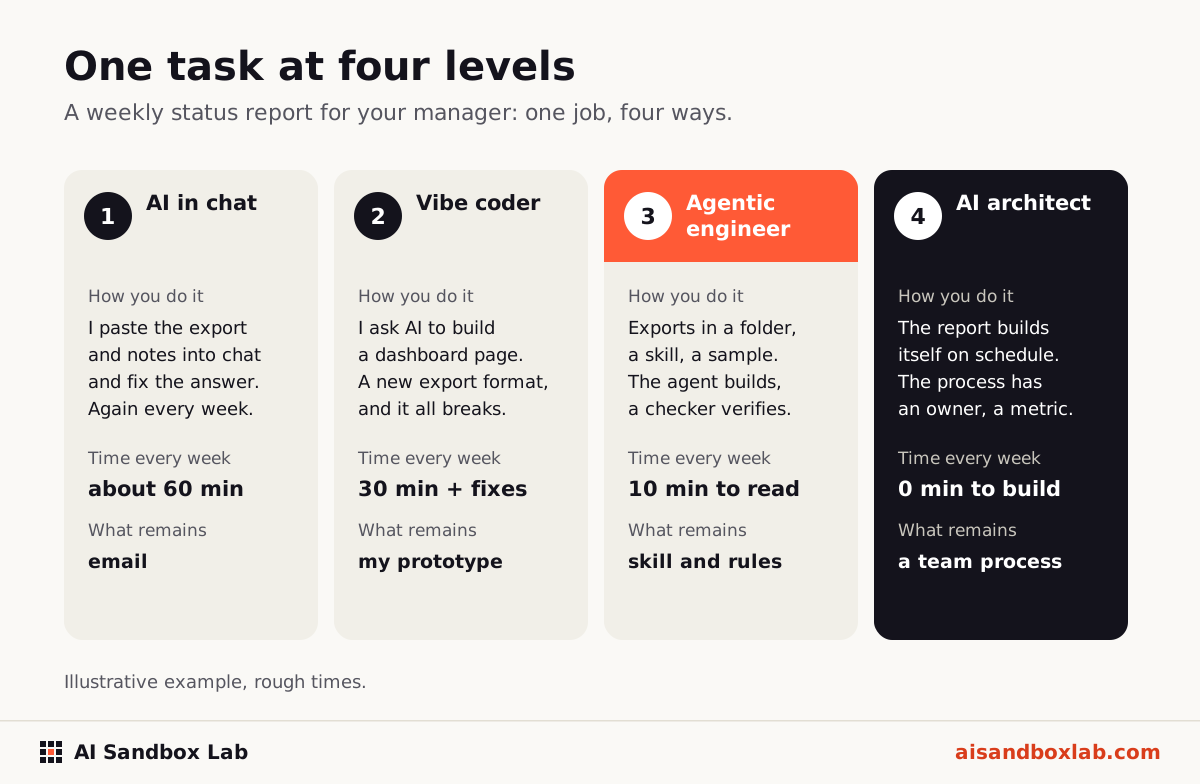
- In chat, every week you copy the export and notes again, ask for a summary, fix it by hand and move it into an email. From week to week nothing remains except the email itself.
- A vibe coder asks AI to build a dashboard page from the export. It looks impressive until someone changes a field in Jira and everything breaks. The prototype lives with you and only with you.
- An agentic engineer sets up a folder once: exports, a sample of a good report, a "build the status" skill and rules. After that it takes one sentence to the agent, a second agent checks the numbers against the export, and you spend ten minutes reading the finished report.
- An AI architect connects Jira directly, the report builds itself on a schedule and goes to the whole team. Time is no longer spent on putting it together, but on keeping the process working: it has an owner and a clear quality metric.
Pay attention to the "what remains" row. Between levels, what grows is not speed by itself, but what builds up from week to week.
How to tell where you are
Think of your usual work week and find the column that looks most like it.
| Sign | 1. AI in chat | 2. Vibe coder | 3. Agentic engineer | 4. AI architect |
|---|---|---|---|---|
| Where AI works | a chat in the browser | one AI service that builds apps | an agent in a project folder on your computer | several agents, connections, access rights |
| How AI knows the task | you explain it again in every chat | you attach files by hand | rules and examples live in the project | context, access and memory are separated |
| What you get | an answer, a text, advice | a prototype that works for you | a skill or process for a recurring task | a system the team uses |
| How you check | you read it: looks fine | you try the main scenario | you set done criteria in advance | automatic checks and error reviews |
| Repeating it a week later | you search for the old prompt that worked | there is a saved prompt | there is a skill and a result template | a shared catalog, the process has an owner |
| Who else uses it | only you, experiments | you, regularly | a colleague, following your instruction | the team, by shared rules |
If your week falls into two neighboring columns, that is normal. Most often it means you are in transition. And the level does not depend on the tool: you can work in Claude Code as if it were a chat, and you can run a very disciplined process in a chat. What matters is how you work. Large companies see this too: at EPAM, which is retraining tens of thousands of engineers to work with agents, Dmitry Tovpeko, head of AI engineering, says that the same tools give very different results in the hands of different people, and that this gap is growing.
What really sets level 3 apart
The move from level 2 to level 3 is the most important and the least understood. From the outside it looks like "installed a different program". In fact two things change: the agent gets a permanent workplace, and the work gets a loop.
The workplace
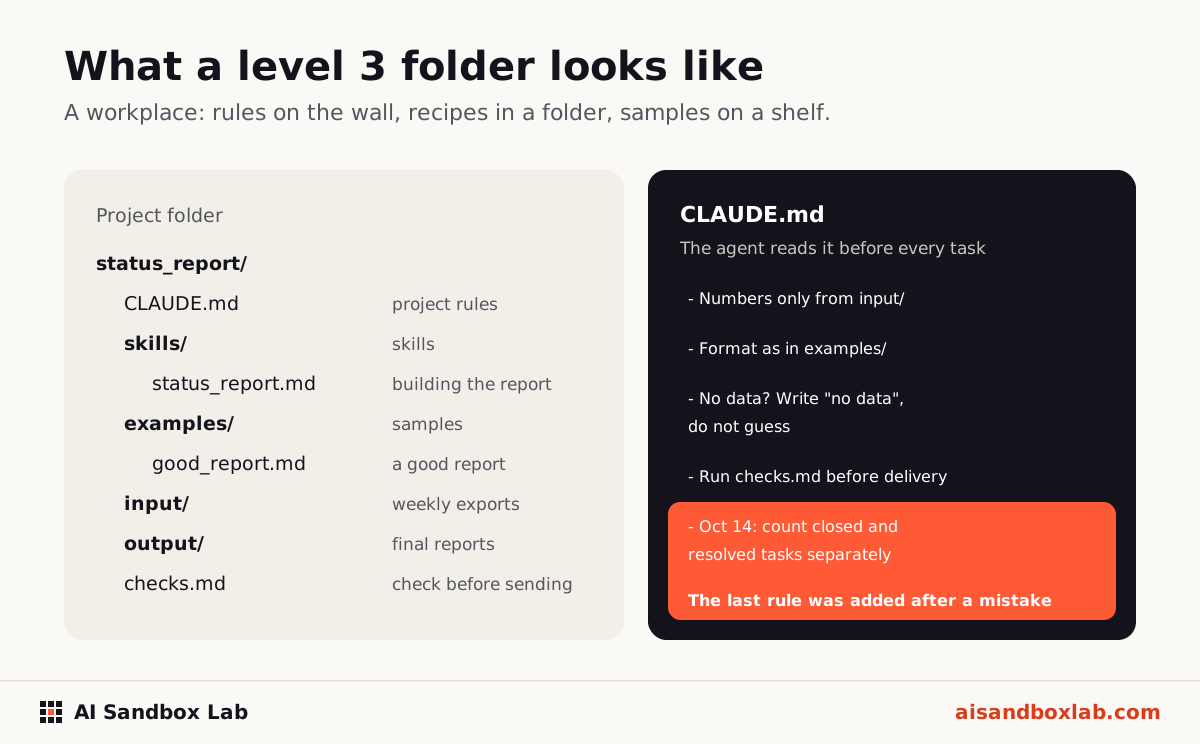
At level 2, all knowledge about the task lives in your head and in the chat history. At level 3 it lives in a folder, and the agent reads it on its own: the project rules, an instruction for the recurring task, a sample of a good result, the source data and a list of what to check before handing it in. That is why tomorrow the task gets done the same way as today, even if you have forgotten half the details.
The work loop
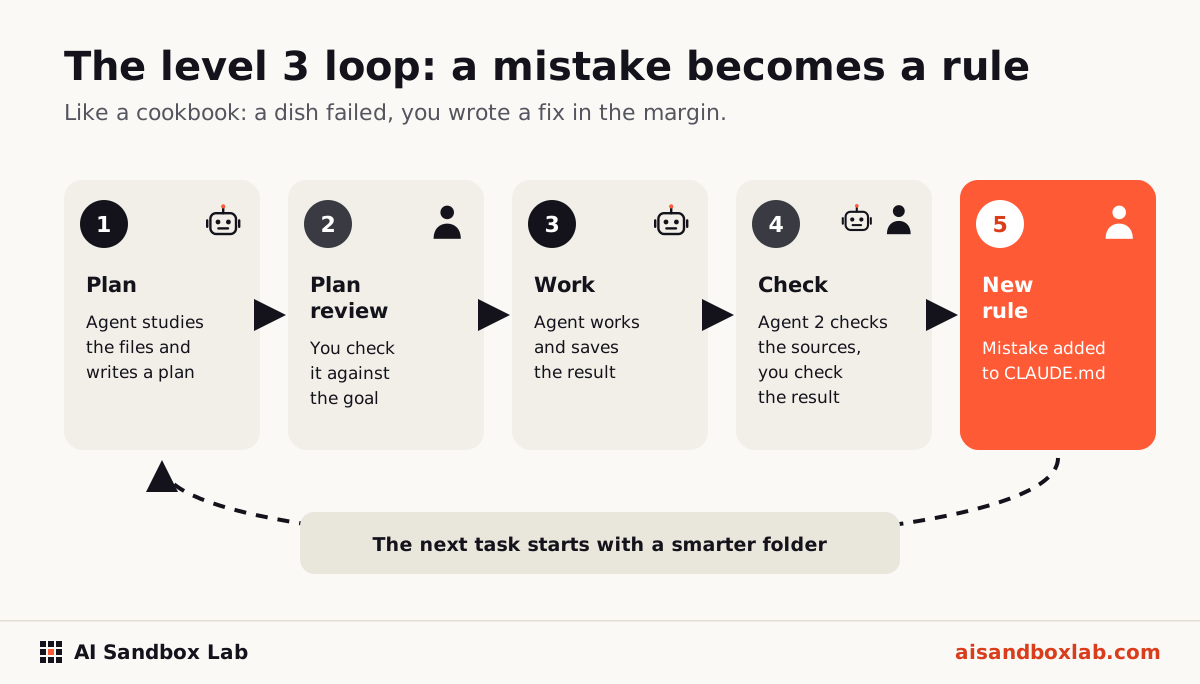
This is also how the people who build these tools work. In its Claude Code recommendations, Anthropic advises asking for a plan first and only then for execution, and above all giving the agent a way to check its own work. Boris Cherny, the creator of Claude Code, says his team keeps a shared rules file and adds a rule to it every time Claude makes a mistake. Karpathy puts the same idea more briefly: the winner is the one with the faster "AI does it, a human checks it" loop.
In its investor presentation (August 2026), EPAM showed how the skills of its engineers are changing. Among the growing ones: setting tasks for AI agents and checking their work, building a process for working with AI, and running several streams of work with agents in parallel. Among the fading ones: manual review "gates", where a person rechecks every step themselves instead of building the check into the process. This is almost word for word a description of our level 3.
An honest caveat: EPAM calls this profile a full-stack agentic engineer and stresses that it grows out of a strong engineering background, not out of a short retraining. For a non-technical professional, level 3 means the same discipline - a folder, rules, a plan and a check - but in your own work: in requirements, reports, test cases and prototypes, not in production code.
For a non-technical professional there is nothing engineering-specific about it. A plan and a check are the native genre of an analyst, a project manager and a tester. Only one thing is new: the last step of the loop. If the agent made a mistake, you do not just fix the result, you add a rule, and next time the agent takes that mistake into account. After a month of working like this, the folder knows more about the task than any single chat.
The trap at each level and how to move up
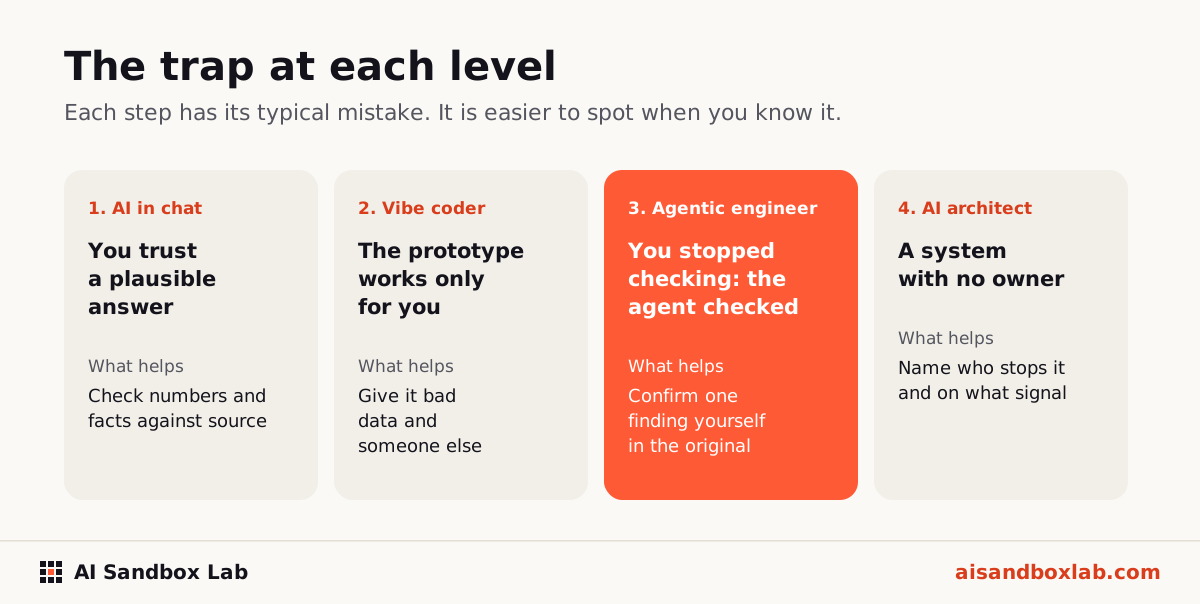
Each transition is blocked not by new terms but by one specific thing. Below is that thing and a small task that helps move it.
From level 1 to level 2
What holds you back: you do not have a single result that does more than answer, one that runs and does something.
A 30-minute task. Take a recurring task: a summary, a brief or sorting through notes. Create a separate folder, put the source material there and ask an AI tool that can work with files to save the result into a new file. Done when the folder holds the source, the instruction and the finished file, and tomorrow you can repeat it without searching for the old chat.
From level 2 to level 3
What holds you back: not the complexity of code. You need permanent context, checking criteria and a repeatable process. Tellingly, at EPAM's AI bootcamp for programming students, the first thing they cover is the difference between vibe coding and spec-driven development, that is, working from a specification, and they teach AI engineering as a discipline, "not as prompt hacking".
A one-evening task. Take your prototype. Write down three signs that it is done, give it a normal input and a deliberately bad one, then fix the most dangerous failure. Save the process that worked as a skill, and the mistake you found as a rule in CLAUDE.md. Done when the main scenario passes twice in a row and the known limitation is written down next to the project.
From level 3 to level 4
What holds you back: you design how a task gets done, but not yet the system around it: connections, access limits, quality control and how other people work with it.
A one-week task. Hand one of your processes to a colleague together with a short instruction. For the first 20 minutes do not help, only write down where the person gets stuck. Done when your colleague reaches the result and you have three places where the process or the instruction needs work.
At level 4
From here, growth depends on reliability, cost and whether the system takes root with other people. For comparison: Cherny himself runs five to ten Claude sessions in parallel. That is already managing several agents, and for most tasks of a non-technical professional it is more than needed. A good question to ask yourself at this level: who will stop the system, and on what signal, if quality starts to drop?
You choose the level for the task
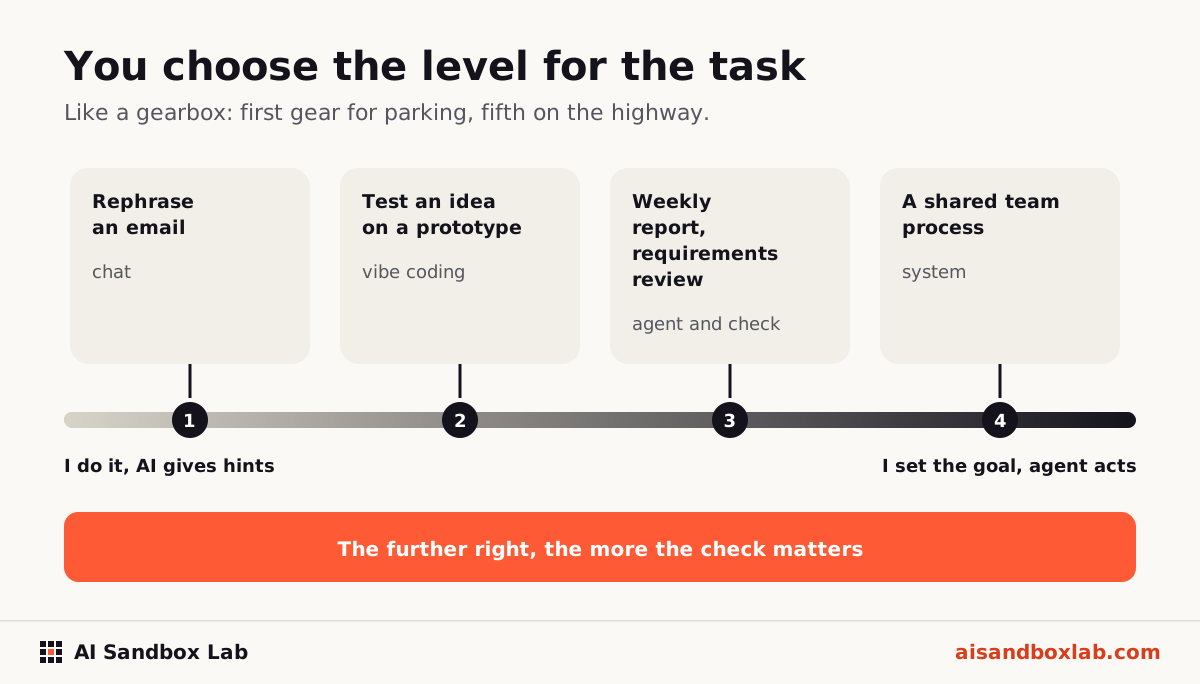
A level is not a rank you get once and for all. Karpathy calls this the autonomy slider: for each task you decide how much to hand to AI. Even Anthropic engineers say they can fully hand off to AI only 0-20% of their work (a survey of 132 employees, December 2025). Level 3 does not mean every task should be done with an agent. It means you can do it when the task is worth it.
And the further right a task sits on the slider, the more the check matters. The Anthropic AI Fluency Index study (February 2026, 9,830 conversations) shows: when AI delivers a finished result, people are 5.2 percentage points less likely to notice that it lacked context, and 3.7 points less likely to check facts. And in a METR experiment, experienced developers working with AI were 19% slower, although they were sure they were faster. This study is from early 2025 and its authors consider it outdated, but the conclusion still holds: feeling fast is not the same as being fast.
Hence a rule for any level. Before you hand a task to AI, answer three questions: what am I handing off, what will I check, and what am I responsible for myself. OpenAI's guide for engineering teams calls this Delegate, Review and Own.
What others say
We compared our scale with about twenty published ladders and models. There is no ready-made "consumer, builder, architect" ladder from a major company. Each one looks from its own side. The most useful:
- Andrej Karpathy gave the language both of our middle levels: vibe coding (2025) and agentic engineering (2026).
- Anthropic, AI Fluency (2025). Four skills: Delegation (deciding what to hand to AI), Description (describing the task clearly), Discernment (evaluating the result) and Diligence (taking responsibility for the result). And three modes of work: Automation, Augmentation and Agency. Agency means setting AI up so that it carries out future tasks for you on its own. That is our level 3.
- EPAM (2026). EPAM has no public scale of levels for people, but in its open investor materials the company describes the profile it is retraining engineers toward, and stresses that the work is changing not only for developers: sales people, account and delivery managers are also moving to agentic tools.
- Section, AI Proficiency Report (June 2026). 5,026 office workers in the US, some skills checked with a practical test. 73.5% use AI often, but one-off, without repeatable processes. Only 5.5% have built AI into repeatable work. A caveat: Section itself sells AI training, so treat the numbers as a rough guide.
Similar ladders exist at Zapier (used to assess candidates in hiring), at Microsoft (three phases for a company, from "a person with an assistant" to "agents run processes under human direction") and from Dan Shapiro for developers. Links below.
Example: a Lead BA in one cohort
"What used to take hours and required consulting colleagues, I can now often do myself."
Olga, Lead Business Analyst, AI Sandbox Lab participant. Let us map her review onto the scale:
- Before the intensive: level 1. "I read articles and kept dozens of tabs open, but I did not understand how to start applying AI in my work."
- During the intensive: level 2. A first small project published on GitHub: a concrete result she can share.
- Now: level 3. Agents and skills for discovery: the right questions about a task, checking the codebase, dependencies and blockers.
- First steps toward level 4. Templates she shares with the team, and internal projects she initiates.
The most visible change in her review is not about tools but about the fear that AI would replace her. It went away once she had a first result made with her own hands. The mapping onto the scale is mine, not a test result.
How to check yourself
The self-assessment on the site will show your level more precisely: 11 questions about what you actually do, 3 minutes, an instant result and no sign-up. Along with your level you get your main gap and three next steps. The self-assessment is currently available in Russian only.
Take the self-assessment (in Russian)
Take it twice: now and a month from now. The difference between the two results is your progress.
Why are the questions about what you do and not about what you know? Sandra Loughlin, Chief Learning Scientist at EPAM, called metrics like "how many people completed the training" an illusion of competence: a skill counts only if you apply it in real work. The same goes for a self-rating like "I am pretty good with AI".
If the test is not at hand, answer four questions for yourself about the past week:
- Did an agent create or change files for your task on its own?
- Do you have a scenario you repeat every week without explaining it to AI again?
- What exactly did you check in the last AI result before passing it on?
- Does anyone besides you use what you built with AI?
A "yes" to the first two questions is a sign of level 3. The fourth question is about the step toward level 4. And for the third question, "nothing" is never a good answer at any level.
From level 1 to level 3 in 6 sessions
The AI Sandbox Lab intensive is built on this scale. Sessions 1-2: a first prototype, a specification and a prototype online (level 2). Sessions 3-5: memory, skills, your own agents and connecting services (level 3). Session 6: project demos and a plan for adopting AI in your team, the first step toward level 4. You do not need to write code.
Sources
- Andrej Karpathy. Post on vibe coding, February 2025; on the move to agentic engineering (Business Insider), February 2026.
- Anthropic. Claude Code: Best practices for agentic coding.
- How the creator of Claude Code actually uses Claude Code (a review of Boris Cherny's practices).
- Anthropic, Dakan R., Feller J. The AI Fluency Framework, 2025.
- Anthropic. The AI Fluency Index, February 2026.
- Anthropic. How AI is transforming work at Anthropic, December 2025.
- OpenAI. Building an AI-native engineering team, 2025.
- EPAM. Investor Day 2026, transcript (D. Tovpeko, S. Loughlin, B. Fejes), March 2026; Investor Presentation, "Skill Evolution" slide, August 2026.
- EPAM Campus. A!Tech Bootcamp: AI Engineering, 2026.
- Section. AI Proficiency Report, June 2026.
- Zapier. AI fluency rubric and the 2026 update.
- Microsoft. Work Trend Index 2025: The Frontier Firm, April 2025.
- Dan Shapiro. The Five Levels, January 2026.
- METR. Measuring the Impact of Early-2025 AI on Experienced Open-Source Developer Productivity, July 2025.
Читать по-русски · Czytaj po polsku · Чытаць па-беларуску