A cheat sheet from AI Sandbox Lab for people in the practical groups.
- Who it is for: Product Managers, Project Managers, business analysts, QA, Engineering Managers, and anyone who works with AI without a coding background
- Reading time: about 7 minutes
- What is inside: two simple ideas from Japanese practice in learning and manufacturing, and how to apply them to AI agents
The short version
Nobody gets good at working with an AI agent in one go. It is a skill, and it grows by two rules:
- Shu-Ha-Ri answers the question "which stage am I at and what should I do now". First you repeat a model exactly, then you adapt it to yourself, then you create your own.
- Kaizen answers the question "how do I get better tomorrow than I am today". One small improvement after every working session, with no big rebuilds.
Together they give a simple rhythm: take something ready-made, use it, notice what did not work, and write down one fix so that next time is better.
1. Shu-Ha-Ri: three stages of mastery
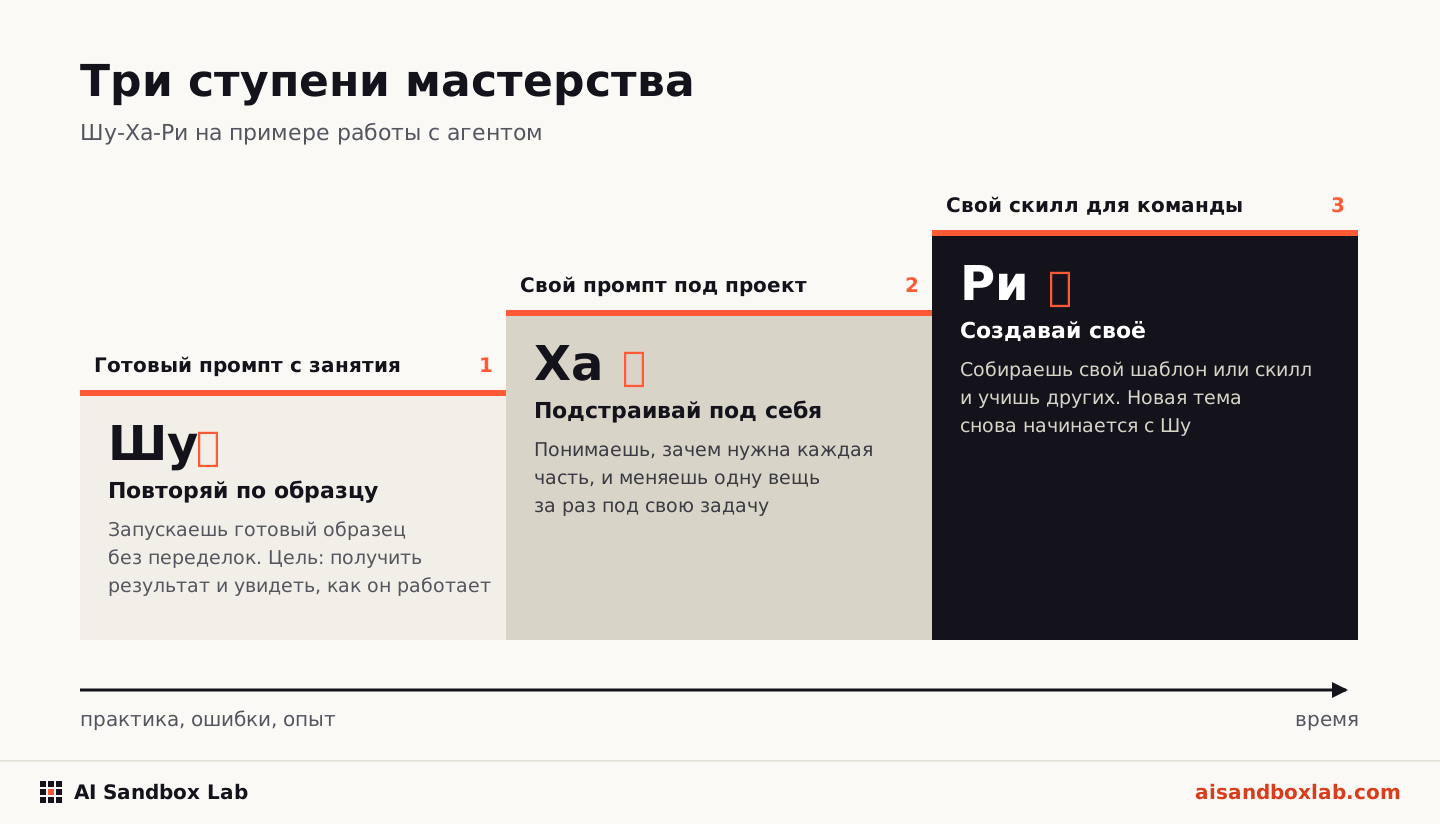
The idea comes from Japanese martial arts. Today it is used in teaching and in teamwork. Three words, three stages, and you climb them in order.
| Stage | Meaning | What you do | Example with an agent |
|---|---|---|---|
| Shu (守) | Keep, obey | You repeat after the teacher exactly, with no changes | You take a ready-made prompt or template from a session and run it as is |
| Ha (破) | Break, depart | You understand why it works and change it for your task | You rewrite the prompt for your project and add your own rules |
| Ri (離) | Leave, be free | You create your own and teach others | You write your own skill or template and share it with the team |
Useful Everyday analogy: a recipe in the kitchen
First you cook by the recipe, gram for gram (Shu). Then you realize you can use less salt, or milk instead of cream, and the dish adapts to you (Ha). In the end you invent your own dish and explain to a friend how to repeat it (Ri).
Examples by role
The same staircase looks different in different professions.
| Role | Shu: I repeat | Ha: I adapt | Ri: I create my own |
|---|---|---|---|
| Product Manager | I run the prompt from the session that turns interview notes into a list of customer problems | I add my own segments and the format in which my product describes problems | I build an "interview analysis" skill and hand it to other Product Managers |
| Project Manager | I take a status report template and fill it in for one week of a project | I add blocks for "risks" and "decisions we need from the client" | I build a chain: the agent assembles the status from notes and drafts the email to stakeholders |
| Business analyst | I run a ready-made prompt that turns a meeting recording into requirements | I change the format to fit my requirements template and add clarifying questions | I build a skill that finds contradictions and gaps in requirements on its own |
| QA | I run a prompt that writes test cases from a feature description | I add my usual checks: boundary values, access rights, errors | I assemble a set of testing rules that the agent follows in all of the team's tasks |
| Engineering Manager | I use a ready-made template to prepare for a one-on-one | I adjust the questions to my people and the team's current goals | I make a retro template and a development plan that other managers use |
Examples from everyday tasks
| Task | Shu | Ha | Ri |
|---|---|---|---|
| Email to a client | I take a ready-made prompt for a polite email and change only the name | I add my own tone and typical phrases from past emails | I collect the best emails into a template that works for the whole team |
| Meeting summary | I run the sample: "outcomes, decisions, tasks" | I add "open questions" and owners with dates | I build a skill that produces a summary in our format after any meeting |
| Rules for the agent | I copy the ready-made rules file from the session | I add my own terms and prohibitions | I keep a single project rules file that the whole team edits |
How not to get the stage wrong
- Do not skip Shu. If you rewrite a prompt without ever running the original, you will not understand what exactly you broke. Run the model once, as it is, first.
- Do not get stuck in Shu. If you have been copying other people's prompts for a month and never changed one, you are not growing. You can move to Ha when you can explain in your own words why each part of a prompt is there.
- Ri does not mean "I know everything". It means you can build your own and hand it to someone else. Masters at this stage also go back to Shu on a new topic.
Important The stage depends on the topic, not on the person
You can be at Ha with prompts and at Shu with agents in a development environment. That is normal. Determine your stage separately for each topic.
2. Kaizen: continuous improvement in small steps
In Japanese, kaizen means "change for the better". The principle is linked to the Toyota production system. The point is that improvements do not wait for a big project: everyone who does the work notices a small obstacle and removes it right away.
Three rules of kaizen:
- A small step. One fix at a time. Not "let us redo the whole process", but "let us add one line to the template".
- Regularly. After every working session, not once a quarter.
- Written down. An improvement that stays in your head gets lost. An improvement in a file keeps working.
The improvement cycle (often called PDCA) fits into four words:
| Step | Question | Example |
|---|---|---|
| Plan | What do we want to get? | I want the agent to produce a project status in the right format |
| Do | We run it | We give the agent the task |
| Check | What worked and what did not? | The agent forgot to list the risks |
| Act | Which single fix would help? | I add the line "always list the risks" to the template |
Examples of small improvements
Kaizen is not about heroic rebuilds. Here is what real small steps look like.
| What I noticed | The one fix I wrote down |
|---|---|
| The agent wrote answers that were too long | Into the rules: "Answer in no more than ten lines unless I ask for more detail" |
| The agent used terms I did not know | Into the rules: "Explain terms in plain words, in one line" |
| I had to remind it of the report format every time | I added a ready-made report format with headings to the template |
| The agent invented a fact that was not in the document | Into the prompt: "If the document does not contain the answer, say so. Do not make things up" |
| The agent forgot about deadlines and owners | I added "who" and "by when" fields to the meeting template |
| The result took a long time to check | Into the prompt: "At the end, list what you checked and what you did not" |
Practice A 5-minute practice: a retro after the session
Finished working with the agent? Answer three questions and save the answers in a notes file:
- What worked well and is worth repeating?
- Where did I have to correct the agent by hand?
- Which single fix to a prompt, template or rules will I make so this does not happen next time?
Then make that fix right away, while you still remember the context.
Useful Prompt: ask the agent to run the retro for you
Paste this at the end of a working session: "Sum up our session. What did we do, where did I correct you, and which three changes to my rules or templates would have helped avoid those corrections? Give me a list, I will pick one."
3. How the two ideas work together
Shu-Ha-Ri shows where you are going. Kaizen shows how you go: one small step at a time.
- At Shu, kaizen looks like this: you run the model and write down what in it was unclear.
- At Ha, you change one thing at a time and see whether it got better.
- At Ri, your accumulated fixes turn into your own template or skill that others use.
Important The agent remembers only what is written down
The agent does not remember past sessions by itself. If you want an improvement to stay, it has to be written into a rules or template file in the project that the agent reads at the start of work. Kaizen with an agent is the regular updating of that file.
A checklist for the week
- ☐ I determined my stage (Shu, Ha or Ri) for one topic, for example "prompts"
- ☐ I picked one model and ran it without changes
- ☐ After every session I wrote down one fix
- ☐ At the end of the week I reread the fixes and kept the ones that really helped
- ☐ I passed one working fix to a colleague or to the group
In short
- Shu-Ha-Ri. Question: which stage am I at? Action: take the next step, that is, repeat, adapt or create.
- Kaizen. Question: what can I improve right now? Action: write down one small fix after the session.
Learn this by doing
In the AI Sandbox Lab practical groups you work with an agent on your own tasks instead of just reading about it. No coding required.
Читать по-русски · Чытаць па-беларуску