The main idea
Automation and AI transformation are different directions. If a company needs transformation specifically, the approach has to be chosen carefully, including the partner who will help.
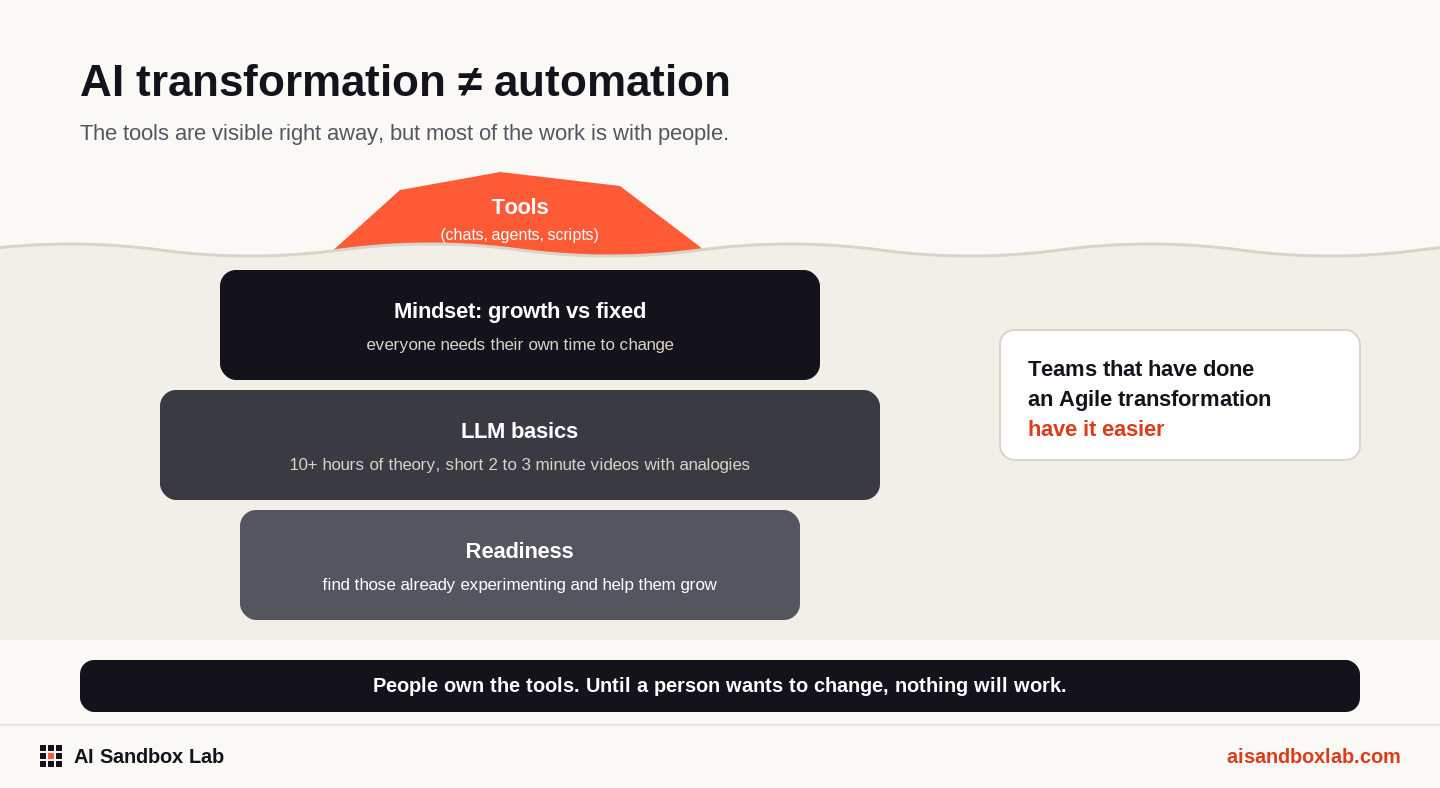
Most of bringing AI into work is about how people think, not about technology. In the end these are just tools, and tools are owned by people. Until a person wants it, nothing will work.
Principles
- Growth and fixed mindset. Some people learn and are ready for change, others are not. Everyone needs their own time to arrive at a personal change. Those who have not been through an Agile transformation find an AI transformation harder.
- People need to understand the basics of LLMs. This is the second big problem after mindset. If you hand over a tool without an understanding of how it works, there will be little use. A person who understands the tool more deeply starts earning with it within a week or two.
- Give them the basics. At least 10 hours of theory. It takes a week or two to understand the fundamentals even a little. Short videos of 2-3 minutes with visuals and analogies from the everyday world help: why the model lies, what it means to overload a chat with information.
- Show it in practice, in a serious game format. For example, take a requirement from a call transcript and immediately build a prototype from it. Or, for a salesperson: you talked to a client, and 5 minutes later there is a polished, checked proposal.
- Goals matter more than training. You can always run a training. The question is the goals: what exactly do we want to get.
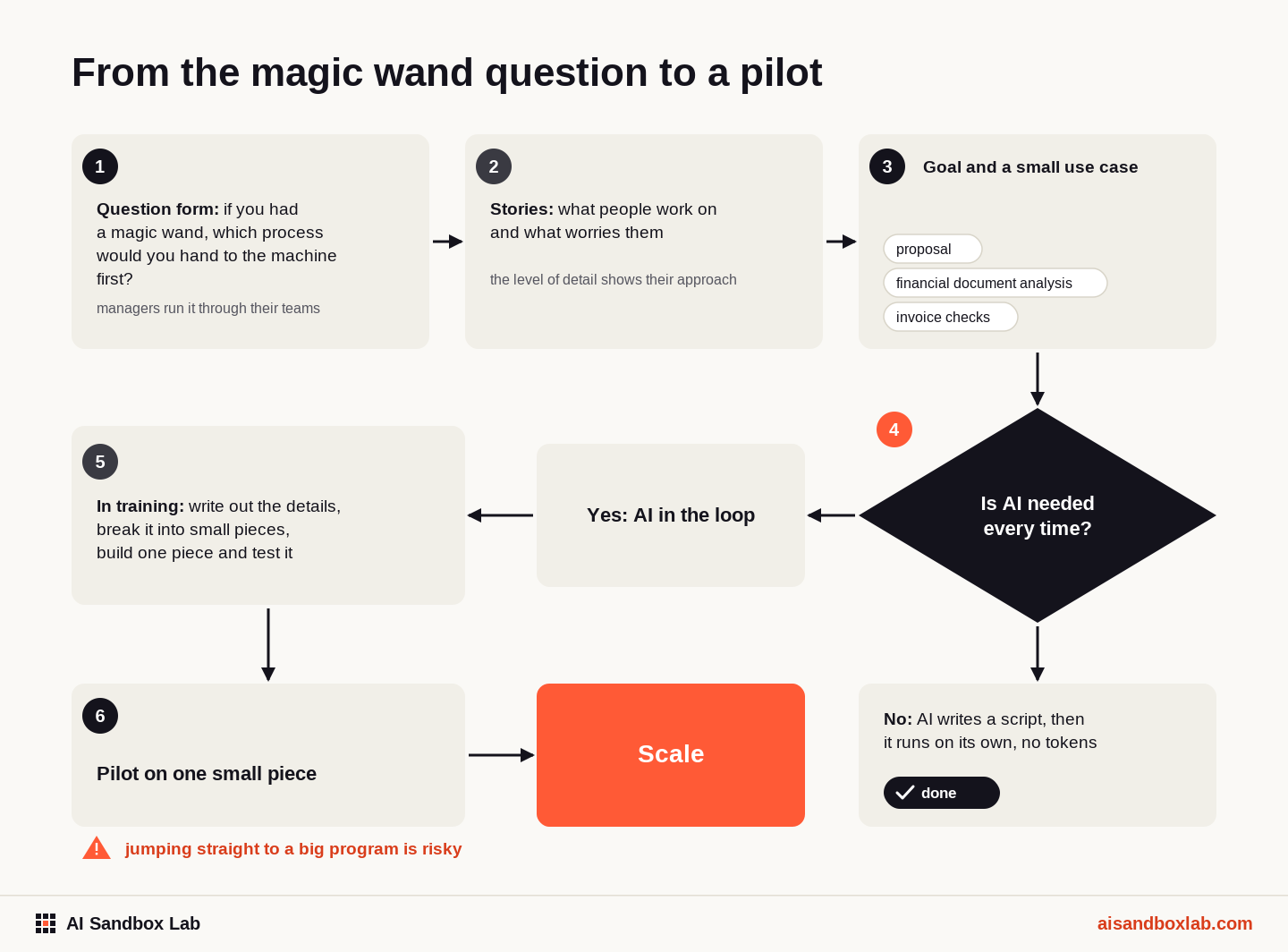
- AI is not needed everywhere. AI can write a script that then runs on its own, and you no longer need to spend tokens on that task.
- A good result comes from AI used with good practices. Just as developing IT products has tests and review, here too there is a difference between a person who was simply let into a chat and a person who understands how it all works.
Step-by-step approach
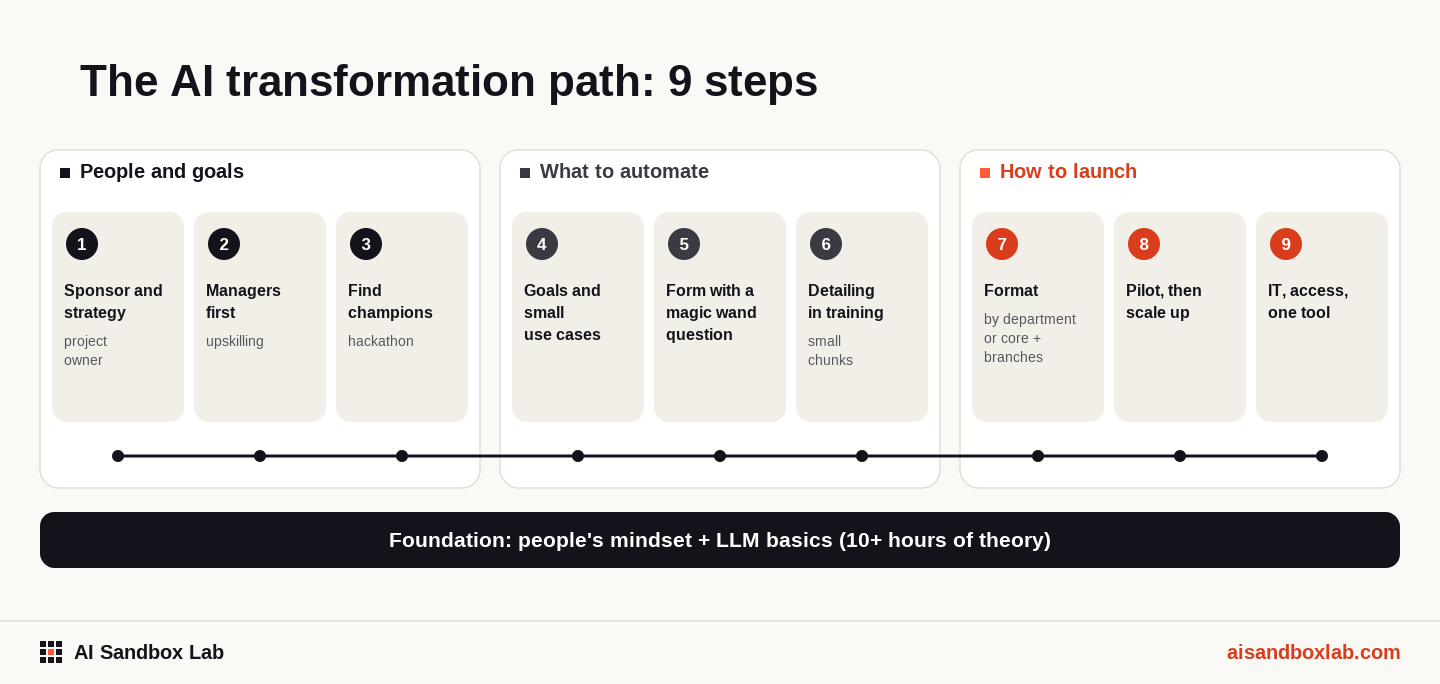
- Sponsor and strategy. You need a project owner, who is usually also the sponsor of the change. The strategy is talked through with them. Then you need helpers: team owners who understand and share the view that this is needed.
- Managers first (upskilling). Representatives of the departments go through a program where they start using AI themselves and learn how to identify champions in their team. If you just send employees to training while the managers themselves do not know how to use it, the outcome will not be good.
- Find the champions. Every department usually has people who have already tried something but do not know where to go next. The task is to find them and help them open up. A hackathon works well for the search: give a minimal tool and see who is active and ready for something new.
- Goals and small use cases. Every use of AI is tied to a small goal. Examples: generating a proposal, calculating financial documents, double-checking issued invoices, writing out an invoice. We collect where AI will give the most value.
- A form with the "magic question". First the employees fill in a form, and the manager runs it through their people. The question: if you had a magic wand, which process would you hand over to the machine first? The level of detail in the answer shows how the person approached the task, and the answers add up to stories about what people spend their time on and what worries them.
- Detailing at the training. The task is described in more detail and broken into small pieces. You take one piece, do it and check how it works.
- Training format. A focus by department works better than something universal. The alternative: a base module for everyone and extra tracks for those with overlapping use cases.
- Pilot before scale. Starting right away with a big program is risky. You can take one small piece, try it, and a lot becomes clear. It is also important to assess the readiness of people from other departments.
- IT, access and the tool. Before the start, find out access to systems, VPN, which systems are being chosen and what security restrictions the IT department has (what can be installed and by whom). At the company level it is easier to manage a single tool.
Common mistakes
- Treating AI transformation as automation and looking only at tools.
- Giving people a tool without LLM basics.
- Sending employees to training when the managers themselves cannot use AI and have not picked champions.
- Launching a big program right away, without a pilot.
- Not setting specific goals and use cases.
- Applying AI everywhere, even where a script is enough.
- Rolling out without the IT department: "without the cooperation of the IT department there will be trouble."
- Starting without understanding who owns the project and who is responsible for it.
How I talk about this with people
- "AI will not replace you, but an employee with AI will replace the employee without AI." Either you are interested, you dive in, become a champion, get noticed and grow, or it is up to fate. I cannot guarantee anything.
- Introducing AI tools is like the 90s: a new Microsoft Office appeared, and you had to learn how to use a computer all over again. Now they are called agents.
- AI native mindset: a person who does not share this idea most likely uses the tool poorly themselves and does not understand the basics of LLMs. To figure it out, you have to sit with it and study, and that is a big effort over yourself.
- People are not ready to learn, and you have to reckon with that: you need to find the ones who are ready.
Where this comes from
I have worked on this topic since 2018. At WorkFusion we built automation for large enterprise clients: recognizing data from invoices and passing it to a CRM automatically, while a person watched to check it was done correctly. Back then you needed engineers to set it up; now everyone has this tool at hand. We use AI in our own work and share that experience.
What the research adds
This section is not from my words: it is a check of the approach against research and guides from companies that build AI (OpenAI, Anthropic, Microsoft, Google), November 2026. The figures are given as in the reports, with links below.
Confirmed. What matters most is people and processes, not the tool: under the BCG 10-20-70 rule, value depends 70% on people and processes. Training needs to be counted in hours, not a single lecture: from 5 hours with live coaching, regular use grows noticeably (BCG). With strong manager support, employees use AI every week 2.1 times more often (Gallup). Small use cases, a pilot, IT from the very start and champions appear in all the vendor guides.
Refined
- People's mindset matters, but it is not the only factor: in the Microsoft 2026 report, about two thirds of the effect of AI is explained by organizational factors (managers, rules, motivation), and personal mindset by about a third.
- Automation is part of transformation, not its opposite: about 3/4 of AI use through the API is automation (Anthropic).
- A pilot without a metric and a decision date turns into an eternal pilot: according to MIT, only 5% of pilots of custom-built solutions reach production.
- Champions are better found than appointed, among those who are already trying, and given recognition.
- One tool is convenient for a start, but prompts, data and processes are worth keeping portable.
- The line about replacement works better together with an answer on what happens to the freed-up time: 52% of workers are worried about the future with AI (Pew).
What to add to the steps
- Rules before the start. A one-page sheet: allowed tools, what data must not be given to AI, who is responsible. Only 30% of employees see an AI policy (KPMG, 2025).
- Measure before the pilot. The time, errors and cost of the process before the start, otherwise the result cannot be proven. Self-assessment cannot be trusted: in the METR study, experienced developers with AI worked 19% slower while thinking they were 20% faster.
- A pilot with criteria. An owner, a metric, a term of 8-12 weeks, and at the end a decision: "scale or close."
- Checking the result. For each use case, 10-20 real examples checked by an expert. On tasks beyond the capabilities of AI, consultants answered correctly 19 percentage points less often (Harvard/BCG).
- Rebuild the process. Leading companies have rebuilt their processes about 3 times more often (McKinsey): a successful piece is built into the process as a whole.
- Time and recognition. Protected time for experiments, recognition of champions, and a leader who uses AI themselves and in plain sight.
- EU law. Article 4 of the AI Act requires training employees in AI basics, with oversight from August 2, 2026. The training is worth documenting.
Sources: BCG AI at Work 2025 and 10-20-70; Gallup; Microsoft Work Trend Index 2026; Anthropic Economic Index; MIT NANDA, The GenAI Divide; Pew; KPMG Trust in AI 2025; METR; Harvard/BCG, Jagged Frontier; McKinsey, The state of AI; OpenAI, AI in the Enterprise; European Commission, AI literacy.
Learn this by doing
In the AI Sandbox Lab practical groups you work with an agent on your own tasks instead of just reading about it. No coding required.
Читать по-русски · Чытаць па-беларуску